Ralph — Founder of Halmer Algo
Transparent multi-strategy trading built around real execution.
Halmer Algo presents a live systematic trading approach centered around multiple independent strategies, portfolio structure and transparent execution via Darwinex.
Transparent live execution
All core strategies are traded live. Performance and risk are meant to be reviewed through Darwinex rather than through isolated screenshots or selectively presented results.
Multi-strategy structure
The portfolio combines different system types and market behaviours instead of relying on a single setup or a single market condition.
Process over promises
The project is built around structure, repeatability and realistic expectations — not exaggerated claims or performance marketing.
DARWIN / Portfolio
Follow the live portfolio through Darwinex.
The Darwinex profile is the main reference point for live performance, execution behaviour and risk normalization. Instead of copying selected metrics here, the project keeps performance transparency where it can be reviewed directly.
- • The systems behind the portfolio
- • The broader trading structure
- • The process and philosophy
- • Selected examples and documentation over time
Darwinex Zero Referral
Join Darwinex Zero with my referral link.
If you want to start with Darwinex Zero, you can use my referral link below.
Use coupon code ZEROPARTNER_20 to receive up to 20% off on eligible subscription plans.
This is a referral link. I may receive a commission from Darwinex Zero if you subscribe through it.
Referral Benefit
Use coupon code ZEROPARTNER_20 for up to 20% off on eligible plans.
Additional Halmer Algo Bonus
Additional Halmer Algo bonus offers may be available for selected referrals, subject to verification, availability and personal-use terms.
Important Notice
This does not constitute investment advice. Any trading system or bonus provided by Halmer Algo would be for personal use only and without any guarantee of results.
Portfolio architecture
Multiple systems, different roles, one structured portfolio.
Halmer Algo is not built around a single trading idea. The portfolio combines multiple components with different behaviour profiles across markets. Some systems are designed for volatility expansion, others for shorter duration opportunities or controlled range behaviour. The goal is diversification of logic rather than dependence on one market regime.
Expansion
Breakout and volatility systems aim to participate in directional expansion when market conditions align.
Mean Reversion
Managed range and pullback components can contribute during quieter or consolidating market phases.
Short Duration
Scalping-style execution captures smaller opportunities with tighter trade management and defined trading windows.
Portfolio Thinking
The objective is not one perfect system, but a diversified structure of components with different roles and behaviours.
Strategy Overview
A broader portfolio beyond the selected systems shown here.
My trading approach is based on a diversified portfolio of systematic and semi-systematic strategies designed to operate under different market conditions.
Instead of relying on a single trading concept, multiple strategies are combined to reduce dependency on specific market environments.
Across the broader portfolio, more than 15 strategy concepts have been developed over time. Not all systems are active simultaneously. Depending on volatility, trend structure and market behaviour, strategies may be activated, reduced or temporarily paused.
The four strategies presented on this website represent selected examples from this broader portfolio and are meant to illustrate the overall structure of the approach.
Strategy Portfolio Philosophy
Open Range Breakout Strategy
Captures intraday momentum after price breaks defined session ranges. Focus on structured breakout entries with clearly defined risk and no overnight exposure.
Managed Grid Strategy
Range-based trading approach designed to collect profits during consolidation phases. Unlike fully automated grid systems, this strategy is actively monitored and managed to reduce structural risks.
Scalping Breakout Strategy
Short-term breakout system targeting momentum moves after structural highs and lows are exceeded. Focus on controlled exposure and tight risk management.
ATR Breakout Strategy
Volatility expansion strategy entering after abnormal price movements relative to ATR. The system accepts small losses while targeting larger winners through asymmetric risk structure.
Portfolio Context
Beyond the four strategies presented here, the overall portfolio includes additional systems that may be deployed depending on market conditions.
Some strategies are paused during periods of excessive volatility or structural breakouts, while others are activated when market conditions become favourable.
This flexible deployment is part of the portfolio risk management philosophy and reflects a dynamic rather than static approach to systematic trading.
Research & Development
In addition to the live strategies shown here, further systems are continuously being developed and evaluated.
Current research includes longer-duration trend continuation strategies that aim to enter markets after strong directional moves during the first meaningful pullback into key moving average zones.
These concepts typically involve structured multi-entry scaling, moving average pullback zones, ATR-based stop logic and dynamic trailing management.
As with all strategies, new concepts are only added to the documented portfolio after sufficient testing and validation.
Detailed Strategy Documentation
Selected systems in more detail.
The sections below provide a more detailed description of selected strategies currently documented on the website.
Open Range Breakout Strategy
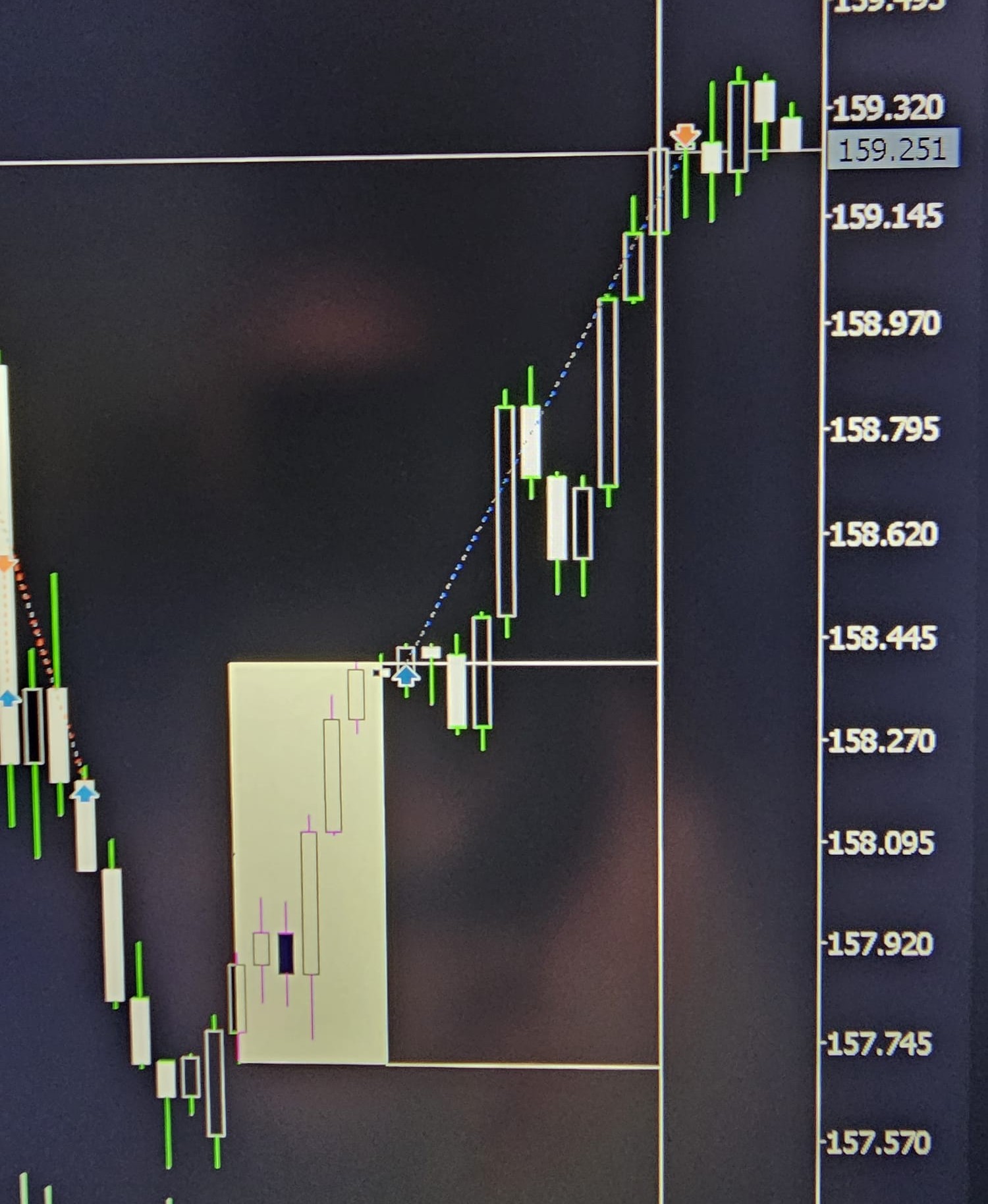
Opening Range BreakoutCaptures intraday momentum after price breaks defined session ranges. Focus on structured breakout entries with clearly defined risk and no overnight exposure.

Strategy Idea
The Open Range Breakout (ORB) strategy is based on the observation that markets often establish a price range during a defined time window. Once this range is broken, directional momentum frequently develops.
The system identifies this initial range and executes trades when price breaks above or below the defined levels, aiming to capture structured intraday movements rather than predicting market direction.
Markets Traded
The strategy is applied across several liquid markets including Nasdaq, Gold, USDJPY, GBPUSD and additional liquid instruments when suitable.
The system is adaptable and can be deployed across different assets depending on volatility and market conditions.
Entry Logic
The strategy defines a price range during a predefined session window. The high and low of this range form the breakout levels.
Trades are triggered when price exceeds these levels. Different entry variants can be used depending on market behavior.
- • Immediate breakout entry when price exceeds the range level
- • Confirmation entry after candle close outside the range
- • Inside bar filter, where trades are only triggered after price exits consolidation structures
These variations help reduce false breakouts and improve trade quality.
Exit Logic
The strategy focuses on controlled trade management rather than fixed profit predictions.
- • Time-based exits
- • Range-based profit targets
- • Opposite range levels
- • Risk-defined stop losses
No trades are normally held overnight in order to reduce gap risk and unexpected volatility exposure.
Risk Management
Risk management is a core part of the system design.
- • Defined stop-loss levels
- • Range-based position sizing
- • Portfolio-based risk allocation
- • Optional break-even logic
- • Optional trailing stop functionality
Trailing stop and break-even mechanisms are implemented but currently not used in live trading, as testing indicated that fixed exits provided more robust results for this strategy.
This reflects the general philosophy of only using features that demonstrate measurable benefits in testing and live trading.
Filters Used
- • Range size filter (minimum and maximum range conditions)
- • News filter (optional trading pause during major events)
- • Inside bar filter
- • Time filters
- • Optional trend filter
The trend filter is built into the system design but is currently not used in live deployment, as testing showed no consistent improvement across the traded assets.
Strategy Philosophy
The ORB strategy focuses on capturing structured market moves rather than predicting direction. The goal is to participate when markets transition from consolidation into movement phases.
- • Simplicity
- • Robust rules
- • Controlled exposure
- • Transparency
- • Only using features that prove their value in testing
Key Characteristics
- • No overnight exposure
- • Clear entry logic
- • Defined risk control
- • Multi-market application
- • Systematic execution
Notes
Like any breakout strategy, performance depends on market conditions. Periods of consolidation may produce smaller results, while strong directional phases typically provide better opportunities.
The strategy is continuously monitored and adjusted when necessary.
Managed Grid Strategy
Controlled Mean ReversionRange-based trading approach designed to collect profits during consolidation phases. Unlike fully automated grid systems, this strategy is actively monitored and managed to reduce structural risks.


Strategy Idea
The Managed Grid Strategy is designed to operate in consolidating market environments where price oscillates within a defined range. The goal of the system is to systematically collect smaller profits during sideways market phases.
Unlike fully automated grid systems, this approach is actively monitored and managed to reduce structural risks typically associated with grid trading.
Markets Traded
The strategy is mainly applied to markets that show stable liquidity and predictable volatility behavior.
- • Indices
- • Oil
- • Selected Forex pairs
- • Other liquid markets during range conditions
Market selection depends strongly on current volatility structure and trend behavior.
Entry Logic
The system places grid orders within a defined price range. Depending on the configuration, the strategy can operate with buy orders only, sell orders only, or both directions.
Orders are typically placed at predefined distance intervals (grid spacing).
If price approaches the upper boundary of a range, sell positions may be opened at defined intervals. When price moves lower toward the next grid level, positions are closed for profit. The same logic applies in the opposite direction for buy setups.
This allows the system to systematically collect profits during sideways market phases.
Risk Considerations
Grid strategies inherently carry structural risks if price leaves the defined trading range. For this reason, this strategy is intentionally not operated as a fully autonomous system.
Instead, it is actively monitored and managed.
- • Active supervision
- • Manual intervention when necessary
- • Avoiding uncontrolled position accumulation
- • Use only in suitable market conditions
This reflects the philosophy that grid systems require experience and supervision rather than blind automation.
Active Management Approach
When price leaves the defined range, manual management decisions are applied.
- • Monitoring breakout behavior
- • Waiting for pullbacks after breakout attempts
- • Defining protective stop levels if a trend confirms
- • Allowing positions to continue if breakouts fail
This discretionary oversight is based on long-term market experience and aims to reduce structural grid risks.
Trend Usage Variant
A second use case of the strategy involves trading pullbacks within established trends.
If a strong trend is identified, for example through long-term moving averages such as the 200-period average, the grid may be used to accumulate positions in trend direction.
- • Moving average alignment
- • Break of previous swing highs
- • Volatility structure
- • Market structure analysis
In this configuration, the grid is used to scale into pullbacks rather than trade pure ranges.
Risk Management
Risk control is based on a combination of manual supervision, dynamic stop placement when needed, portfolio risk awareness and position sizing control.
Stop losses are not always predefined automatically but may be applied dynamically based on market behavior.
This flexible risk management reflects the discretionary component of the strategy.
Additional System Capabilities
- • Position scaling options
- • Adjustable take profit logic
- • Alternative grid spacing models
- • Automated stop placement options
These options exist within the system design, but the strategy emphasizes controlled deployment rather than maximum automation.
Strategy Philosophy
The Managed Grid Strategy is based on the understanding that grid systems can be effective tools when used selectively and responsibly, but can become dangerous when used without supervision.
- • Selective deployment
- • Active monitoring
- • Risk awareness
- • Experience-based management
The system is intentionally used as a managed strategy rather than a fully automated black-box approach.
Key Characteristics
- • Active supervision
- • Market-condition-dependent usage
- • Flexible configuration
- • Risk-aware deployment
- • Combination of systematic execution and discretionary management
Notes
This strategy is not intended as a fully passive system. It requires monitoring and is only deployed when market conditions are considered suitable.
This reflects a conservative approach focused on risk control rather than aggressive automation.
Scalping Breakout Strategy
Short-Duration Breakout TradingShort-term breakout system targeting momentum moves after structural highs and lows are exceeded. Focus on controlled exposure and tight risk management.


Strategy Idea
The Scalping Breakout Strategy focuses on capturing short-term momentum moves after price breaks significant local highs or lows.
The system identifies structurally relevant price levels based on recent market structure and places trades when these levels are exceeded. The objective is to capture fast directional moves while maintaining tightly controlled risk.
Markets Traded
The strategy is primarily applied in liquid Forex markets and has also shown strong applicability in Gold.
- • USDJPY
- • GBPUSD
- • EURUSD
- • Gold (XAUUSD)
The system currently operates mainly on the 1-hour timeframe, which has shown stable performance during testing.
Entry Logic
The system identifies local highs and lows based on configurable structural criteria. This includes defining how many candles must form before and after a price level for it to qualify as a valid swing point.
- • Buy orders are placed slightly above significant highs
- • Sell orders are placed slightly below significant lows
This allows the strategy to enter trades when price shows signs of continuation beyond established market structure.
Trade Development Logic
After entry, the system allows some initial room for price movement, recognizing that breakouts often include short pullbacks before continuation.
- • The trade is allowed controlled breathing room
- • No premature exit is triggered
- • Risk remains predefined
This helps avoid early exits caused by normal market noise.
Risk Management
Risk is controlled through structured stop placement and dynamic trade management.
- • Defined initial stop-loss
- • Risk-based position sizing
- • Portfolio-based exposure control
Position sizing can be calculated based on stop distance and account size, allowing consistent risk allocation across trades.
Trade Management
Once a trade moves into profit, the system may activate trailing stop mechanisms to protect gains.
- • Trailing stop functionality
- • Break-even protection logic
- • Progressive risk reduction after profit thresholds
These mechanisms aim to protect capital while allowing winning trades to develop.
Strategy Variations per Market
Different instruments require slightly different parameter configurations due to their volatility characteristics.
- • GBPUSD often requires slightly wider stops due to consolidation behavior
- • USDJPY typically allows tighter stop-loss placement with larger reward potential
- • EURUSD may require longer trade development phases and later trailing activation
- • Gold can show especially strong breakout behaviour during active session transitions
These differences are handled through parameter optimization rather than structural changes to the strategy.
Time Filters
The system includes configurable trading windows. This allows exclusion of time periods with historically weaker performance or lower liquidity.
News Handling
The system supports optional news filters to pause trading during major events.
However, news trading can also produce strong momentum moves. Therefore, this filter is configurable and may be enabled or disabled depending on market behavior.
Strategy Monitoring
Like all strategies in the portfolio, performance is continuously monitored.
If a system enters a weaker performance phase, risk exposure may be temporarily reduced through lower position sizing.
Likewise, when favorable market conditions appear, the strategy may benefit from strong directional moves such as breakout phases in metals or Forex markets.
Strategy Philosophy
The Scalping Breakout Strategy focuses on structured participation in momentum moves rather than frequent trading.
- • Controlled risk per trade
- • Structural entries
- • Systematic execution
- • Continuous performance monitoring
- • Adaptive risk exposure
The strategy is designed to generate consistent opportunities while keeping downside risk controlled.
Key Characteristics
- • Structural breakout entries
- • Tight risk control
- • Configurable time filters
- • Risk-based position sizing
- • Multi-market applicability
- • Active performance monitoring
Notes
Performance may vary depending on market volatility and structural conditions. The system is continuously evaluated and adjusted when necessary.
The goal is consistent long-term performance rather than short-term optimization.
ATR Breakout Strategy
Volatility ExpansionVolatility expansion strategy entering after abnormal price movements relative to ATR. The system accepts small losses while targeting larger winners through asymmetric risk structure.


Strategy Idea
The ATR Breakout Strategy is designed to capture strong momentum moves following unusually large price movements.
The core concept is based on volatility expansion: when price moves significantly more than average, it often indicates the beginning of directional continuation.
The system identifies these abnormal price movements using the Average True Range (ATR) and enters trades in the direction of the move.
Markets Traded
The strategy is currently applied to several liquid markets including Nasdaq, Gold, USDJPY and GBPUSD.
The approach is designed to work best in markets that show strong momentum behavior after volatility expansion.
Entry Logic
The strategy identifies unusually large candles relative to recent volatility.
- • A candle exceeds a defined multiple of the ATR
- • Candle structure meets predefined criteria
- • Momentum characteristics are confirmed
Typical structural filters may include candle body size relative to total range, wick structure requirements and volatility expansion thresholds. Trades are typically entered at the open of the following candle after the signal is confirmed.
Risk–Reward Structure
The strategy follows an asymmetric risk model.
- • Small predefined stop-loss
- • Significantly larger take profit
- • High reward-to-risk ratio
The system is designed to accept multiple small losses while relying on occasional strong winners to generate overall profitability. This reflects a probability-based trading approach rather than win-rate optimization.
Trend Filter
An additional trend filter is included to improve trade selection.
This allows trades to be taken only in the direction of the prevailing market trend.
The filter parameters such as timeframe and moving average periods are configurable. This improves the probability of capturing continuation moves rather than counter-trend noise.
Time Filters
The strategy includes configurable trading windows.
This allows exclusion of historically weak periods such as low liquidity hours and helps improve signal quality.
Risk Management
Risk is controlled through predefined stop-loss placement and position sizing logic.
- • Risk-based position sizing
- • Fixed stop-loss distance
- • Portfolio-based exposure control
The strategy emphasizes capital preservation through small controlled losses rather than large drawdowns.
Strategy Behavior
Due to its asymmetric risk structure, the strategy naturally produces frequent small losses and occasional larger winners.
This behaviour is typical for momentum breakout strategies and reflects a mathematically driven trading approach.
Strategy Philosophy
The ATR Breakout Strategy focuses on exploiting volatility expansion rather than predicting price direction.
- • Volatility-based entries
- • Asymmetric risk structure
- • Statistical edge
- • Systematic execution
- • Robust parameter logic
The goal is to participate in strong market moves while maintaining controlled downside risk.
Key Characteristics
- • ATR-based entry logic
- • High reward-to-risk structure
- • Trend filtering capability
- • Configurable time filters
- • Multi-market deployment
- • Risk-based position sizing
Notes
Performance depends on the presence of momentum conditions. Periods of low volatility may produce fewer opportunities, while strong market phases typically provide the best results.
The strategy is continuously monitored and adjusted when necessary.

About Ralph
A long-term market participant with a systematic and risk-focused approach.
My name is Ralph and I have been involved in financial markets since 1986. My journey started with long-term equity investments, which built the foundation of my understanding of market behaviour across multiple economic cycles.
Over the decades I have followed markets through crashes, bull markets, structural changes and volatility regimes, developing a strong focus on risk awareness and capital preservation.
My early activities focused mainly on equities, complemented by structured products such as warrants and occasional derivatives trading, including periods of activity on futures markets.
One of my first motivations for developing more active trading approaches was not speculation, but protection. Early strategy ideas were often intended to hedge existing investments, including currency exposure, market drawdowns and downside scenarios in equity portfolios.
A major turning point came from recognizing that even good trading ideas often failed because of emotional execution. Positions were closed too early, plans were not followed consistently and emotions interfered with decision-making.
This led me to the conclusion that the issue was often not the strategy idea itself, but the discipline of execution. As a result, I increasingly focused on structured and automated trading approaches.
My transition into algorithmic trading was also influenced by the educational work of René Balke (BMTrading.de), whose material helped me understand how discretionary ideas could be translated into rule-based and testable trading systems.
Based on that foundation, I gradually developed my own strategy variations and improvements, which later evolved into a broader multi-strategy trading framework.
Today, my focus is on building robust systems, controlling downside risk and maintaining transparency through structured execution and external tracking environments such as Darwinex.
YouTube
A YouTube channel is planned as a future extension.
The channel is intended to document ideas, systems and trading-related topics over time. Content will primarily be in German and can later be embedded directly into the site.
Interest List
Register interest in selected systems.
Some strategies may become available later if there is sufficient interest. This would only happen in a structured and limited way. The form can also be used to stay informed about future updates.
Contact
Contact via email only.
For business inquiries and interest list questions:
halmer-algo@wolke7.net
Live performance and ongoing execution can be reviewed through Darwinex.
Imprint
Information according to § 5 DDG
Ralph Halmer
Wilhelm-Tent-Str. 8
53913 Swisttal
Germany
Email:
halmer-algo@wolke7.net
Business activity:
Development and documentation of algorithmic trading strategies.
Privacy Policy
Privacy notice
This website processes personal data only where necessary, especially when information is submitted voluntarily through the interest list form.
Data that may be processed includes:
• name
• email address
• broker information
• system interest
• optional notes
Purpose of processing:
• communication regarding inquiries
• management of the interest list
• responding to requests related to this project
Hosting providers and technical services may automatically process technical connection data such as IP addresses for security and delivery purposes.
Data submitted through the interest list is not sold or shared for advertising purposes.
If you want information about stored data or want your data to be deleted, contact:
halmer-algo@wolke7.net
Risk Disclaimer
Trading involves substantial risk
Trading foreign exchange, indices, commodities or other leveraged financial instruments involves substantial risk and may not be suitable for all investors.
Past performance is not indicative of future results. Any information presented on this website is provided for informational purposes only and does not constitute investment advice, financial advice or a recommendation to buy or sell any financial instrument.
All trading and investment decisions remain solely the responsibility of the individual user or investor.
Only capital you can afford to lose should be exposed to market risk.